Acute Limb Ischemia
Acute limb ischemia is a sudden, severe reduction in arterial blood flow to an arm or leg. The limb may become painful, pale or blue, cold, numb, weak or difficult to move. It is a vascular emergency: go immediately to the nearest hospital emergency department. Do not wait for a clinic appointment, website reply, telephone call or WhatsApp response.
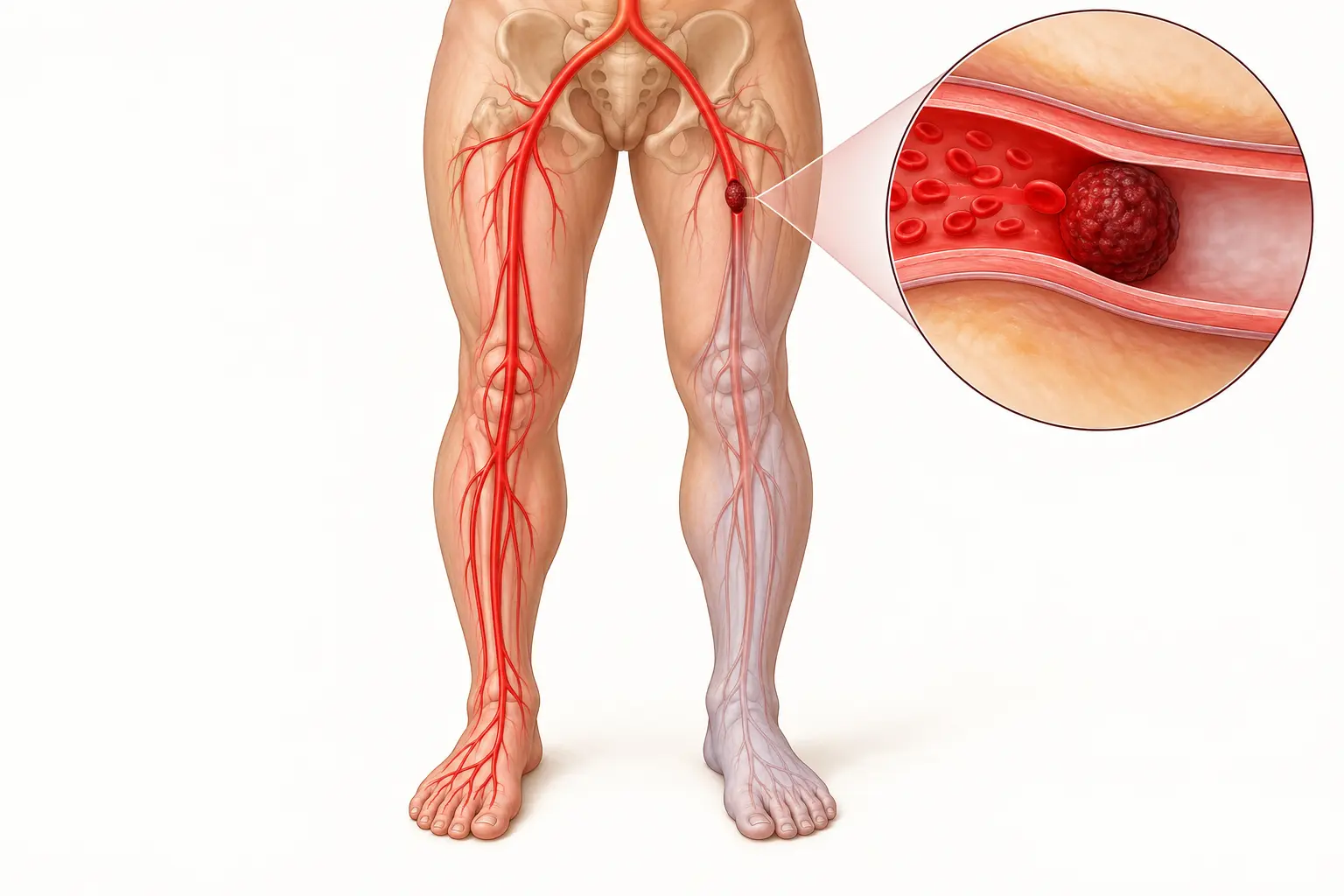
Warning signs: the six Ps
Symptoms often begin suddenly or worsen rapidly. Traditional warning signs include:
- Pain: sudden severe limb pain, including pain at rest
- Pallor: pale, mottled or blue discolouration
- Pulselessness: a pulse that is absent or markedly reduced
- Paresthesia: tingling, altered sensation or numbness
- Paralysis: new weakness or inability to move the foot, toes, hand or fingers
- Poikilothermia: the limb feels colder than the other side
Not every patient has all six signs. Numbness and weakness are particularly concerning because they may indicate that nerves and muscles are becoming ischemic.
What causes acute limb ischemia?
Possible causes include:
- Embolism: a clot travels from the heart, aorta or another artery and suddenly blocks a limb artery
- Arterial thrombosis: a clot forms within an artery already narrowed by atherosclerosis
- Thrombosis of a previous reconstruction: sudden blockage of a stent, bypass graft or treated artery
- Aneurysm-related thrombosis or embolisation
- Arterial trauma or dissection
- Less common clotting or vascular disorders
Atrial fibrillation, recent heart attack, known aneurysm, peripheral arterial disease, previous vascular procedures, smoking and some clotting disorders may increase risk, but ALI can occur without a previously recognised vascular diagnosis.
Why treatment cannot wait
Muscle and nerve tissue tolerate severe ischemia poorly. The longer a threatened limb remains without adequate blood flow, the greater the risk of permanent nerve injury, muscle damage, amputation, kidney complications after reperfusion and death.
The correct action is immediate emergency assessment. Patients should not massage the limb, exercise to “restore circulation”, apply tight bandages, eat or drink in anticipation of a possible procedure, or start medication based on website advice.
Emergency assessment
Limb viability
The emergency team assesses pain, colour, temperature, capillary refill, sensation, muscle power and arterial and venous Doppler signals. These findings help classify the limb as viable, threatened but salvageable, immediately threatened, or irreversibly damaged.
New sensory loss or weakness can change the urgency of treatment and must be reported immediately.
Identifying the level and cause
The history includes the exact onset, previous claudication or rest pain, atrial fibrillation, heart disease, aneurysm, vascular procedures, trauma, medication and bleeding risk. Both limbs are examined and the heart and abdomen may also be assessed.
Imaging
Duplex ultrasound, CT angiography or catheter angiography may be used to locate the blockage and plan treatment. When a limb is immediately threatened, additional imaging must not delay necessary revascularisation. The treating vascular team determines which tests can be performed safely without losing critical time.
Hospital treatment
Treatment depends on the cause, duration, anatomic level, severity of ischemia, limb viability, bleeding risk and the patient’s overall condition.
Immediate medical treatment
Hospital treatment commonly includes urgent anticoagulation with unfractionated heparin unless contraindicated, together with pain control, intravenous access and monitoring. This is clinician-directed emergency treatment; patients should not self-administer or alter blood-thinning medication.
Surgical thrombectomy or embolectomy
Open removal of clot may rapidly restore flow when an embolus or accessible thrombosis is responsible. Additional angiography, angioplasty, stenting, patch repair or bypass may be required if underlying arterial disease remains.
Catheter-directed thrombolysis
Clot-dissolving medication delivered through a catheter may be considered for selected patients when the limb is salvageable and the expected benefit outweighs bleeding risk. It is unsuitable when revascularisation must be immediate or when thrombolysis is contraindicated.
Endovascular thrombectomy and angioplasty
Aspiration or mechanical thrombectomy, angioplasty, stenting or a combined approach may be used depending on the clot, underlying lesion, equipment and expertise available.
Open bypass or arterial reconstruction
Bypass, endarterectomy, arterial repair or another open reconstruction may be required when clot removal alone is insufficient, the anatomy is unsuitable for an endovascular approach, or trauma has disrupted the artery.
Fasciotomy and reperfusion care
Restoring blood flow can cause swelling within muscle compartments and release metabolic products into the circulation. Selected patients require fasciotomy and close monitoring of kidney function, potassium, acid-base status, muscle injury and compartment pressure.
When the limb may not be salvageable
An irreversibly ischemic limb may have profound anaesthesia, paralysis, fixed mottling and absent arterial and venous Doppler signals. Revascularising non-viable tissue can cause severe systemic harm. In this situation, amputation may be necessary to protect life.
This determination requires experienced emergency vascular assessment. It cannot be made from a photograph or website checklist.
Acute limb ischemia versus CLTI
Acute limb ischemia develops suddenly, usually over hours or days, and is an emergency. Chronic limb-threatening ischemia develops through chronic arterial disease and presents with persistent rest pain, non-healing wounds or gangrene. A patient with CLTI can also develop an acute-on-chronic occlusion, producing sudden deterioration that must be treated as an emergency.
After emergency treatment
Follow-up may include surveillance of the treated artery, stent or bypass; investigation of an embolic source such as atrial fibrillation; review of anticoagulant or antiplatelet therapy; cardiovascular risk reduction; wound and rehabilitation care; and monitoring for recurrent ischemia.
Routine vascular follow-up can be arranged after the emergency episode. New sudden symptoms should always return through emergency care rather than the outpatient pathway.
Frequently asked questions
Can acute limb ischemia improve on its own?
It should never be watched at home. Symptoms may fluctuate, but continuing arterial obstruction can cause irreversible damage. Immediate hospital assessment is required.
How is acute limb ischemia different from chronic PAD?
Chronic PAD usually develops gradually and may cause walking-related pain. ALI is a sudden major reduction in arterial flow and may rapidly threaten the limb. Chronic PAD can be the background on which an acute thrombosis occurs.
Does every patient need surgery?
Not every patient needs the same procedure. Treatment may involve open thrombectomy, catheter-directed thrombolysis, mechanical thrombectomy, angioplasty, stenting, bypass or amputation when the limb is irreversibly damaged. The choice depends on limb viability, cause, anatomy and patient risk.
Why do numbness and weakness matter?
They may indicate that nerves and muscles are becoming ischemic. Progressive sensory loss or weakness suggests a threatened limb and increases the urgency of revascularisation.
Is a scan always required before treatment?
Imaging often helps locate the blockage and plan treatment, but it must not delay revascularisation when the limb is immediately threatened. The emergency vascular team decides the safest sequence.
Should I take aspirin or another blood thinner before reaching hospital?
Do not self-start or change medication based on website information. Go immediately to hospital and tell the team which medicines you already take. Emergency anticoagulation is prescribed after assessing bleeding risk and contraindications.
Can acute limb ischemia recur?
Yes. Recurrence prevention depends on the cause and may include treatment of atrial fibrillation or another embolic source, surveillance of a reconstruction, medication and risk-factor management.
Vascular consultation in Bengaluru
Routine outpatient assessment is available with Dr Siddharth Matad, Vascular & Endovascular Surgeon, at Siddharth Vascular Clinic, United Hospital, Jayanagar, Bengaluru.
For emergency symptoms, go directly to the nearest hospital emergency department.